Agentic AI in the Enterprise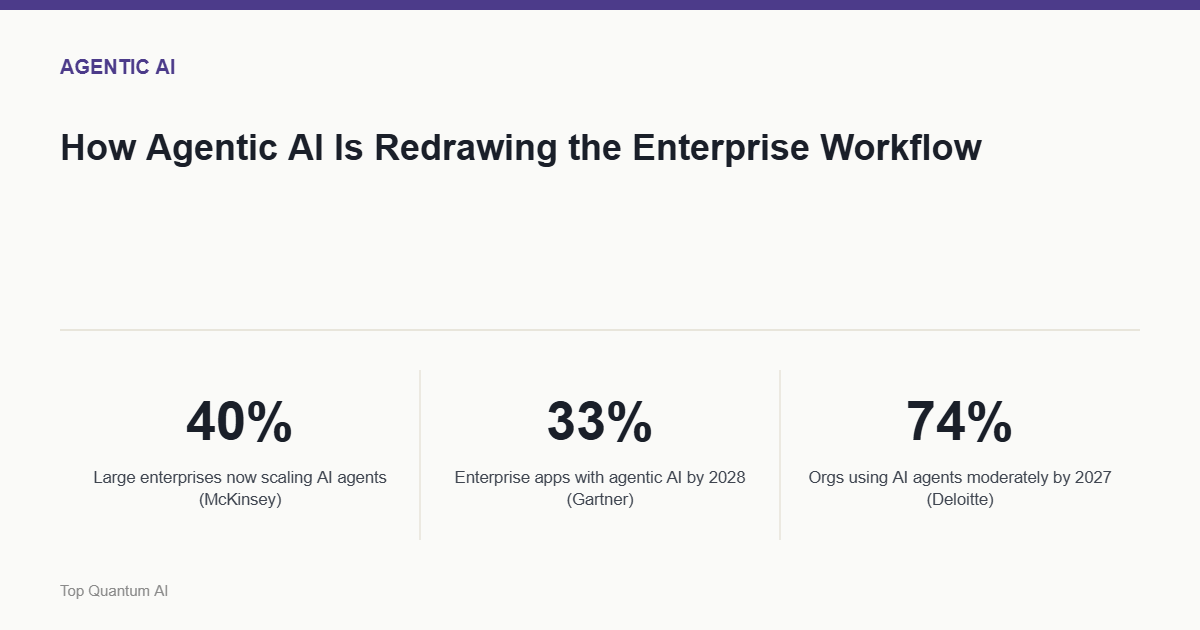
How Agentic AI Is Redrawing the Enterprise Workflow
Enterprise software spent much of the past two years running AI models that answered questions. It is now spending on AI agents that complete tasks. That shift, from AI as an assistant to AI as an execution layer inside daily workflows, is the defining story of enterprise technology in 2026.
The clearest evidence is in the pace of scaling. McKinsey's State of AI survey, published in August 2026, found that 40 percent of large organizations, those with more than one billion dollars in annual revenue, now report scaling AI agents into live workflows, up from 27 percent one year earlier (McKinsey and Company, 2026). At smaller organizations the figure held near 22 percent, a gap that points to scale and existing data infrastructure moving faster at large enterprises than at smaller ones. Coding agents show the sharpest concentration: about one in five organizations overall, and nearly a third of larger enterprises, now use agents to write and ship software (McKinsey and Company, 2026).
Where are agents landing first. The same survey points to three functions doing most of the early work: IT operations, knowledge management and software engineering. Technology companies are automating software engineering tasks most heavily. Consumer goods and retail companies are directing agents toward marketing and sales workflows. In advanced manufacturing, agents are taking on supply chain planning, inventory management and production process monitoring (McKinsey and Company, 2026). Each of these functions shares a common trait: high volumes of repeatable decisions that follow clear rules, exactly the terrain where an autonomous system can operate inside a defined scope with a measurable outcome.
Deloitte's State of AI in the Enterprise report, released in January 2026 from a survey of 3,235 business and IT leaders across 24 countries, shows how far this intent extends. 74 percent of respondents expect their organizations to be using AI agents at least moderately by 2027 (Deloitte, 2026). That pace points to a market moving past general purpose demonstrations and into agents built around a specific workflow, a specific dataset and a specific outcome.
Forecasts for where this leads over the next two years are specific enough to plan around. Gartner projects that 33 percent of enterprise software applications will include agentic AI capabilities by 2028, up from less than 1 percent in 2024. The same research projects that 15 percent of day to day work decisions will be made autonomously through agentic AI by 2028, up from effectively zero in 2024 (Gartner, 2025). Investment intent is already building toward that curve. In a Gartner poll of more than 3,400 IT leaders taken in January 2025, 19 percent of organizations described their agentic AI investment as significant and another 42 percent described it as conservative but underway (Gartner, 2025). Combined, that is 61 percent of organizations already committing budget, a base of early investment that lines up with the acceleration McKinsey later recorded in its scaling figures.
The direction of investment is shifting too. Early agentic AI spending concentrated on IT and software functions because technical teams could build and monitor agents directly inside systems they already owned. The next wave, based on where Deloitte and McKinsey both see plans forming, moves into customer facing and operational functions: sales support, service operations and supply chain coordination. Enterprises that build the internal frameworks now, defining what an agent is allowed to decide versus what still routes to a person, are positioned to move from a handful of scaled use cases to the broader function coverage that survey data suggests is coming within two years.
For companies mapping where to place their next agentic AI investment, the data points to a sequence rather than a single leap. Start where decision rules are clear and data is structured, in IT, engineering or knowledge management, then extend into the function specific workflows where competitors in each industry are already concentrating, whether that is marketing and sales in retail or supply chain planning in manufacturing. The organizations reporting the fastest scaling today share exactly that pattern, entering through a well defined operational task before expanding the agent's scope.
The pace of change between the two most recent large scale enterprise surveys, a jump from 27 percent to 40 percent scaling among large organizations in a single year, suggests the next twelve months will move faster still. Enterprise workflow design is being rewritten function by function, and the organizations furthest along are treating each new agent deployment as a template for the next one rather than a standalone project.